Dislocation (1D defects)
Dislocation basics
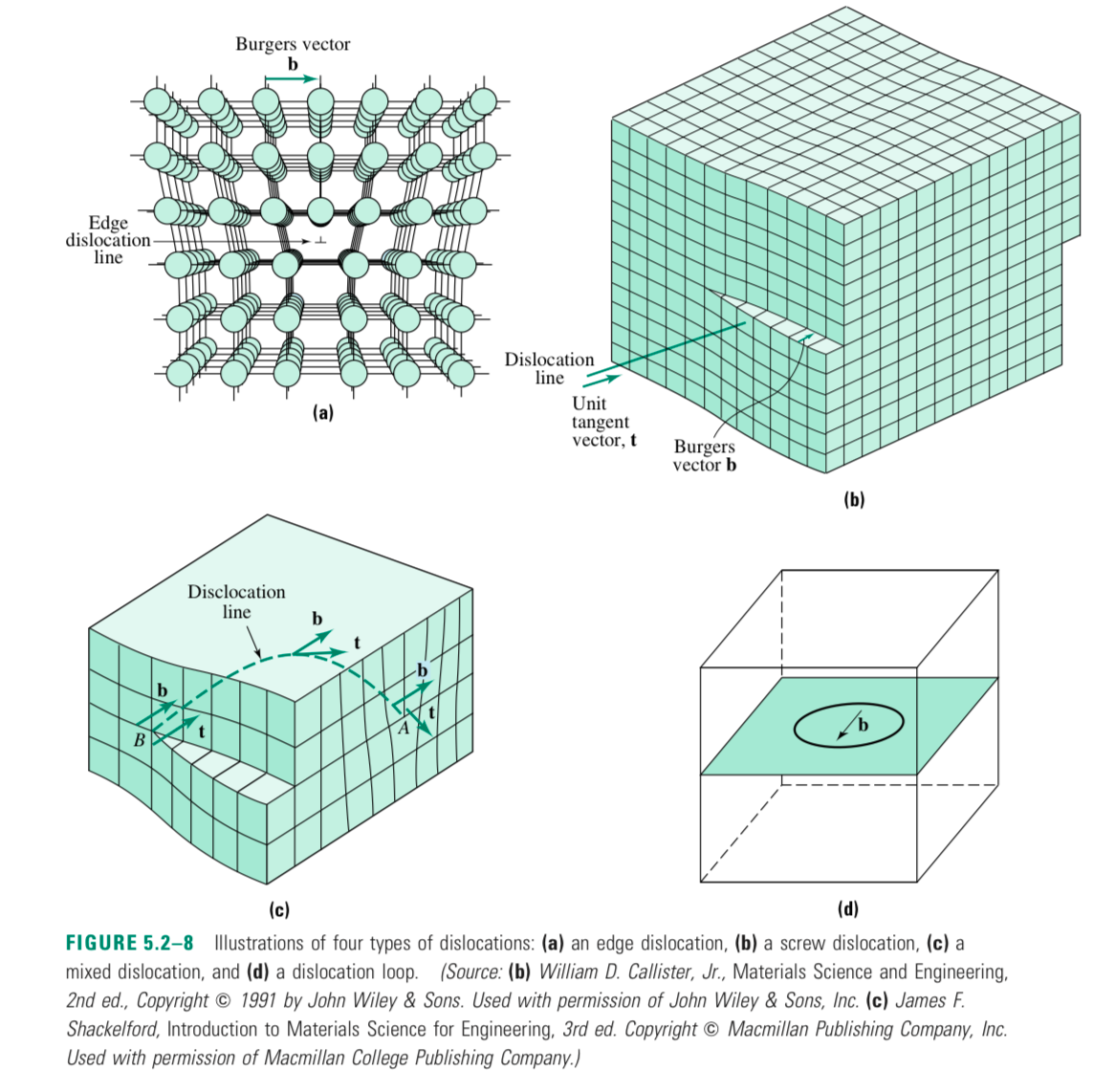
Burgers vector, tangent vector, and slip plane
- Burgers vector
- The same dislocation shares the same
- Unit tangent vector
- Slip plane
Edge dislocation
- Edge dislocation
- Edge dislocation symbol
- Vertical line: half plane, broken bonds
- Horizontal line: slip plane
Screw dislocation
- Screw dislocation
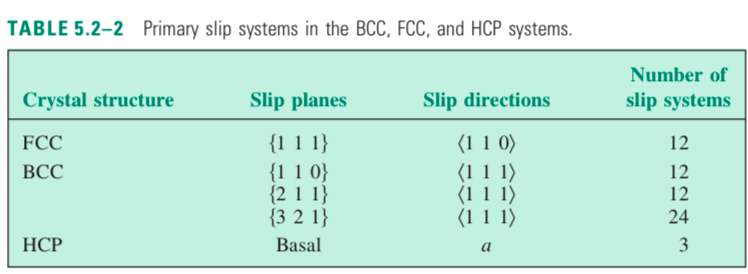
Slip system
Usually, the slip system corresponds to the highest-density plane.
Force on dislocation: Peach-Koehler force
The Peach-Koehler formula gives us the force on a dislocation line under a stress field :
Properties
The shear stress needs to have a component in the direction. For pure shear with magnitude , is perpendicular to :
Here, the Burgers vector is and the direction of the dislocation is given by a unit vector .
This force controls the movement of the dislocation (line). Because of the dot product, the force/movement will always be perpendicular to the dislocation line.
Strain, stress, and self-energy of dislocation
With the Peach-Koehler formula, we are able to obtain the force on a dislocation line under a stress field. If we have the stress field of another dislocation, we can calculate the force “between” the two dislocations.
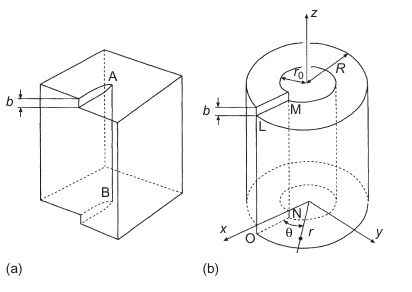
Strain field, stress field of a dislocation
Here, denotes the shear modulus of the system and denotes the Poisson ratio.
Results
| Screw dislocation | Edge dislocation | |
|---|---|---|
| Strain | ||
| Stress | ||
| Self energy |
Important points:
- Stiffer materials have higher dislocation energy, .
- Comparatively, edge dislocation will have higher energy because of the term.
- Strain falls off as .
See also
- Point defects (0D defects), which has more of a thermodynamic aspect.
- Science and Design of Engineering Materials has a really good chapter on this topic.
- Lecture 9 - Forces on Dislocations.pdf (imechanica.org)
- Lubarda, Vlado A. “Dislocation Burgers Vector and the Peach–Koehler Force: A Review.” Journal of Materials Research and Technology, vol. 8, no. 1, Jan. 2019, pp. 1550–65. ScienceDirect, https://doi.org/10.1016/j.jmrt.2018.08.014.
- Peach, M., and J. S. Koehler. “The Forces Exerted on Dislocations and the Stress Fields Produced by Them.” Physical Review, vol. 80, no. 3, Nov. 1950, pp. 436–39. APS, https://doi.org/10.1103/PhysRev.80.436.